Fashioning Tech
  • Home
  • Fashion
    • Fashion

      Kinetic Couture: Introducing the Butterfly Dress

      January 25, 2017

      Fashion

      Kate Spade Brings Whimsy to Wearables

      August 29, 2016

      Fashion

      Aerochromics: Pollution Monitoring Garments Aim to Become A Sixth Skin

      August 17, 2016

      Fashion

      ‎BODYSONG‬./Glitchaus GLITCHJK Jacquard Bomber Jacket

      February 27, 2016

      Fashion

      3D Print and the Jewellery Industry: An Overview

      December 11, 2015

  • Fitness
    • Fitness

      Biomimicry and Sports Apparel

      August 15, 2016

      Fitness

      Bring A Little Bling To Your Workout with Misfit’s Solar-Powered Activity Trackers Made From Swarovski Crystals

      January 6, 2015

      Fitness

      Wearables in Contemporary Ballet

      November 18, 2014

      Fitness

      Fibers Software Transforms Your Fuelband Data into Art

      August 19, 2014

      Fitness

      Adidas Reissues Micropacer OG

      August 14, 2014

  • Healthcare
    • Healthcare

      Fashionable therapy brightens winter SADness

      July 30, 2015

      Healthcare

      Lightwear: An Exploration in Wearable Light Therapy for Seasonal Affective Disorder

      February 4, 2015

      Healthcare

      Vigour — A Gorgeous Wearable For Rehabilitation and Physical Therapy

      December 18, 2014

      Healthcare

      Space: What to wear?

      June 7, 2014

      Healthcare

      E-textile Pillow for Communication Between Dementia Patients and Family

      November 5, 2013

  • Wearables UX
    • Wearables UX

      Moff: Wearable Smart Toy For Kids

      August 21, 2014

      Wearables UX

      Temporary NFC Tattoo

      July 29, 2014

      Wearables UX

      Wearable Tech Guide to SXSW

      March 7, 2014

      Wearables UX

      PixMob’s LED beanies light up the SuperBowl by turning the crowd into human pixels

      February 3, 2014

      Wearables UX

      Cadbury Joy Jackets

      January 16, 2014

  • Interviews
    • Interviews

      Interview with Davide Vigano of Heapsylon

      April 30, 2014

      Interviews

      Make It Wearable Video Series by Creators Project

      April 3, 2014

      Interviews

      Interview with Sparkfun’s Dia Campbell

      March 26, 2014

      Interviews

      Interview with Julia Koerner

      March 20, 2014

      Interviews

      Interview with Akseli Reho from Clothing Plus

      March 17, 2014

  • Materials
    • Materials

      Conductive Tattoos Turn Your Skin Into An Interface

      August 24, 2016

      Materials

      Biofabrication: The New Revolution in Material Design

      August 23, 2016

      Materials

      Aerochromics: Pollution Monitoring Garments Aim to Become A Sixth Skin

      August 17, 2016

      Materials

      Biomimicry and Sports Apparel

      August 15, 2016

      Materials

      Smart Fabrics Conference May 11 - 13

      April 27, 2015

  • DIY
    • DIY

      Techno Textiles - Concordia University

      January 18, 2016

      DIY

      Smart Fabrics + Wearable Technology 2015 Review

      July 8, 2015

      DIY

      Explore and Learn from the Students of the Wearables Class at CCA

      April 19, 2015

      DIY

      Make It Wearable Winners

      November 4, 2014

      DIY

      JPG Data Knit Blanket Series from Glitchaus

      September 22, 2014

  • About

Fashioning Tech

for fashion futurists & wearable tech enthusiasts

  • Home
  • Fashion
    • Fashion

      Kinetic Couture: Introducing the Butterfly Dress

      January 25, 2017

      Fashion

      Kate Spade Brings Whimsy to Wearables

      August 29, 2016

      Fashion

      Aerochromics: Pollution Monitoring Garments Aim to Become A Sixth Skin

      August 17, 2016

      Fashion

      ‎BODYSONG‬./Glitchaus GLITCHJK Jacquard Bomber Jacket

      February 27, 2016

      Fashion

      3D Print and the Jewellery Industry: An Overview

      December 11, 2015

  • Fitness
    • Fitness

      Biomimicry and Sports Apparel

      August 15, 2016

      Fitness

      Bring A Little Bling To Your Workout with Misfit’s Solar-Powered Activity Trackers Made From Swarovski Crystals

      January 6, 2015

      Fitness

      Wearables in Contemporary Ballet

      November 18, 2014

      Fitness

      Fibers Software Transforms Your Fuelband Data into Art

      August 19, 2014

      Fitness

      Adidas Reissues Micropacer OG

      August 14, 2014

  • Healthcare
    • Healthcare

      Fashionable therapy brightens winter SADness

      July 30, 2015

      Healthcare

      Lightwear: An Exploration in Wearable Light Therapy for Seasonal Affective Disorder

      February 4, 2015

      Healthcare

      Vigour — A Gorgeous Wearable For Rehabilitation and Physical Therapy

      December 18, 2014

      Healthcare

      Space: What to wear?

      June 7, 2014

      Healthcare

      E-textile Pillow for Communication Between Dementia Patients and Family

      November 5, 2013

  • Wearables UX
    • Wearables UX

      Moff: Wearable Smart Toy For Kids

      August 21, 2014

      Wearables UX

      Temporary NFC Tattoo

      July 29, 2014

      Wearables UX

      Wearable Tech Guide to SXSW

      March 7, 2014

      Wearables UX

      PixMob’s LED beanies light up the SuperBowl by turning the crowd into human pixels

      February 3, 2014

      Wearables UX

      Cadbury Joy Jackets

      January 16, 2014

  • Interviews
    • Interviews

      Interview with Davide Vigano of Heapsylon

      April 30, 2014

      Interviews

      Make It Wearable Video Series by Creators Project

      April 3, 2014

      Interviews

      Interview with Sparkfun’s Dia Campbell

      March 26, 2014

      Interviews

      Interview with Julia Koerner

      March 20, 2014

      Interviews

      Interview with Akseli Reho from Clothing Plus

      March 17, 2014

  • Materials
    • Materials

      Conductive Tattoos Turn Your Skin Into An Interface

      August 24, 2016

      Materials

      Biofabrication: The New Revolution in Material Design

      August 23, 2016

      Materials

      Aerochromics: Pollution Monitoring Garments Aim to Become A Sixth Skin

      August 17, 2016

      Materials

      Biomimicry and Sports Apparel

      August 15, 2016

      Materials

      Smart Fabrics Conference May 11 - 13

      April 27, 2015

  • DIY
    • DIY

      Techno Textiles - Concordia University

      January 18, 2016

      DIY

      Smart Fabrics + Wearable Technology 2015 Review

      July 8, 2015

      DIY

      Explore and Learn from the Students of the Wearables Class at CCA

      April 19, 2015

      DIY

      Make It Wearable Winners

      November 4, 2014

      DIY

      JPG Data Knit Blanket Series from Glitchaus

      September 22, 2014

  • About
Author

Melissa Coleman

DIY

Exhibition Pretty Smart Textiles in Belgium

written by Melissa Coleman


After successful editions in The Hague (2010), Denmark (2011) and a mini-edition in Vienna as part of the exhibition Techno Sensual, the exhibition Pretty Smart Textiles will now for the first time be shown to a Belgian audience. The Textiles Open Innovation Centre TIO3 has opened its doors to the work of innovative designers on the edge of fashion, art and technology in the emerging world of interactive electronic textiles.

Works by:

Bart Hess, Floris Kaayk, Lucy McRae, Jalila Essaïdi, Rogier van der Heide, Maartje Dijkstra, Beorn Lebenstedt, Nicky Assmann, Anja Hertenberger, Local Androids, Meg Grant, Leonie Smelt, Melissa Coleman, Karina van Heck, Seçil Ugur, Florian Kräutli, Heike Sperber, Django Steenbakker, Aoife Wullur, Ralf Jacobs, Leonie Urff, Laura Duncker, Marina Toeters, Aniela Hoitink, Anbasja Blanken, Martijn ten Bhömer, Kristi Kuusk, Eef Lubbers, Paula Kassenaar, Pauline van Dongen, Daniel Schatzmayr, Charlotte ‘t Hart, Ricardo O’Nascimento, Mandy Smith

About Pretty Smart Textiles
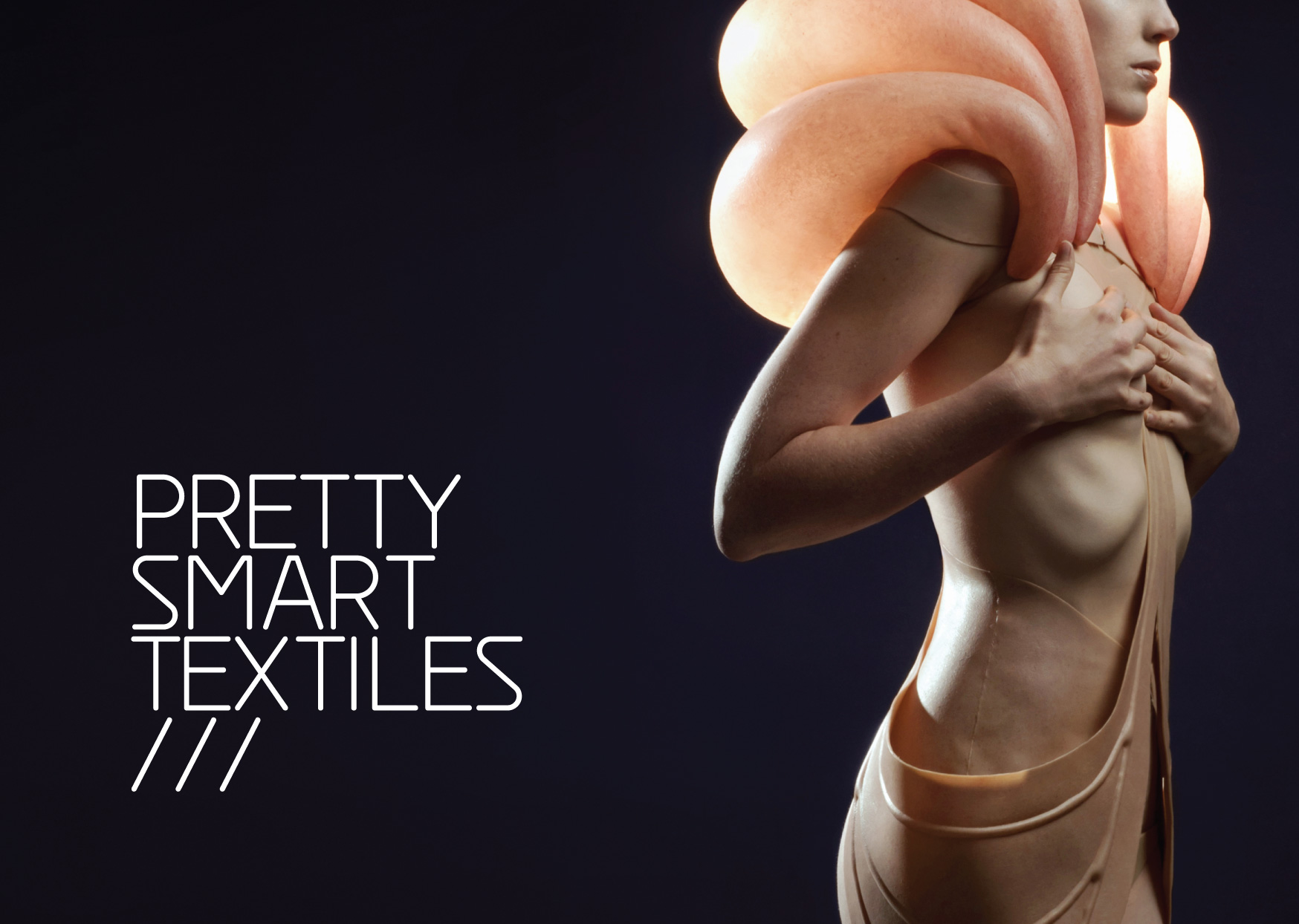
Pretty Smart Textiles is a travelling exhibition showcasing the latest developments in the world of electronic textiles, a new medium at the intersections of fashion, art and technology. The exhibition is an interactive experience leading the viewer through a multi-sensory discovery of new possibilities for garments and interior architecture.

The exhibition explores themes that arise from reflections on technology. Some works visualize psychological dimensions and pinpoint difficulties of social interaction, using technology to externalise or complement the imperfections of human beings. Other works grapple with the abstract and clinical aspects of technology, trying to make the invisible visible and the intangible tangible. But not all works treat technology as a problem to be solved. Some simply embrace the new aesthetics of technology and give textiles a new dynamic through sound, movement and light.

28.10.12 – 16.12.12
Textiles Open Innovation Center TIO3
Oscar Delghuststraat 60
Ronse, Belgium

Visitor Information:
Wed, Fri, Sun 13:00 – 17:00
Tickets 6€/4€

www.prettysmarttextiles.com
www.tio3.be

For information on the frameprogram and workshops visit: www.tio3.be

This edition of Pretty Smart Textiles was made possible through the generous contributions of TIO3 and the exhibition TechnoSensual.
Exhibition Pretty Smart Textiles in Belgium was last modified: October 20th, 2012 by Melissa Coleman
October 20, 2012 0 comment
0 Facebook Twitter Google + Pinterest
Fashion

DENZIPFADEN: an haute couture music controller for fashion conscious DJs

written by Melissa Coleman

Dutch fashion designer Maartje Dijkstra who previously wooed us with her seductive design for Studio Roosegaarde‘s first Intimacy dress is now challenging DJs with an interactive and high fashion approach to controlling tracks. Her latest design DENZIPFADEN combines fashion, music and technology in an atmospheric, junglelistic and dark men’s outfit that allows you to change the volume of your music and add samples -or anything else that you might do with a midi controller- by pulling on the six golden zippers on the suit and a bracelet. The project was developed together with DJ and electronic composer Beorn Lebenstedt (Newk), who developed the technology and wrote music for the suit, which he performed during the opening of the exhibition TechnoSensual in Vienna where DENZIPFADEN is currently on display.


The suit is completely handcrafted out of golden silk and polyester wires and custom made golden zippers. The development of the suit is very specific to the way that Maartje Dijkstra designs, using laborious handcrafting methods to create unique one-of-a-kind pieces that take months to complete. Although she’s now designed two highly technical garments she considers herself quite un-technical, preferring analog materials to digital ones. This preference is clearly visible in the final design of DENZIPFADEN. Although the suit is electronically enhanced it was designed not to appear that way, making the midi-controller function of the suit secondary to its function as a high fashion outfit. And of course keeping the technology hidden also adds a great element of surprise to a DJ set.


I spoke to Maartje about her process of developing DENZIPFADEN and her approach as a fashion designer towards wearable electronics.


When you develop a new collection you will often work by yourself for a long period of time. Is it very different to collaborate with a musician on a wearable piece? Does it change your own process as a fashion designer?


Collaboration automatically changes the creative process because it inspires you. In collaborating with a composer my process did not change much, because music was already a big inspiration for my designs. Newk and I both believe there is no fashion without music and the other way around. Working with a musician like Newk is great, because he makes music that I consider almost the ‘High Fashion of music’. His music is spherical, individualistic and unique and has attention for the little details in sounds. All in all it was an inspirational process for us with an amazing end result.


Having seen the piece in action it occurred to me that performing with DENZIPFADEN creates an inward focus for the DJ. He manipulates the garment on his own body, making the performance intimate. Did you consider this when you created the design and did it change how Newk composed and performed his music?


The first focus in the design and development process was to literally make a bridge between fashion and technology. The process of composing music did not change, because you can use any music for this suit, but the performance part became more intimate than we’d ever thought. The crowd usually does not see the DJ using the mixer. It is hidden behind the DJ desk and is overshadowed by a lot of attitude, arms in the air and jumping. But now, with this suit, the act of mixing can become more expressive. The focus of the performance shifts the audience’s attention towards the technical action of the DJ creating sound effects that would normally go unnoticed. I think it’s an overall enrichment for both the performing DJ and the party people.


One of the things that I particularly like about the piece is how you’ve insisted on not making it instantly recognizable as a piece of wearable electronics. It reminded me of the choice regarding usability that designers have to make for all interactive products to either create controls to be easily recognizable or to make aesthetically pleasing controls that blend in with the overall design. Do you think that if a larger group of fashion designers will start making interactive garments that they will, like you, choose beauty over functionality?


That will depend on the type of fashion designer. I think the choice between functionally and beauty depends on if you consider yourself a commercial designer or someone who designs unique high fashion pieces like myself. If you design high fashion you are focused on the visual and atmospheric properties of the piece, like details in handcrafting, the use of special materials and sculptural silhouettes, and not so much with the ‘wearable’ part of fashion. My opinion is that the term functionality belongs to clothes we wear in our daily life and not to fashion. Fashion needs to stay a discipline and platform to express your most extreme and creative thoughts and ideas. For DENZIPFADEN we only considered practical issues when we designed the interaction for the suit. A DJ or musician needs to use his gear as simply and as fast as he can.


Do you feel that adding electronics is specifically suited to the style of garments you design?


Yes, I think High Fashion is extremely suitable and progressive to combine with technology.


Can we expect more wearable electronics from you in the future?


Oh yes, and I’d especially like to do more collaborations! I’d like to make a high fashion silver woman’s version of the DENZIPFADEN suit. Newk and I will continue developing the technology an­­d in the beginning of 2013 I will start designing my first high fashion men’s collection, all with music/jungle related effects built in. I can’t wait!


Photographer: Michele Pauty
Model: Edgar Retro/Motheragency Vienna


DENZIPFADEN: an haute couture music controller for fashion conscious DJs was last modified: August 14th, 2012 by Melissa Coleman
August 14, 2012 0 comment
0 Facebook Twitter Google + Pinterest
Fashion

Paparazzi Lover

written by Melissa Coleman


Budding starlets craving the attention of the press now have a new way to ensure that all eyes are on them.
 Ricardo O’Nascimento‘s new piece Paparazzi Lover is an interactive dress that lights up when it’s photographed. Feeding on the sea of camera flashlights it responds with 62 embedded led lights that cleverly direct our eyes to the direction of the wearer, making her the centre of the attention.


The dress was created in collaboration with Dutch fashion designer 
Anbasja Blanken during O’Nascimento’s artist in residency at the Museum Quartier in Vienna for the upcoming tech-couture exhibition 
TechnoSensual. Currently being in Vienna myself I had the opportunity to speak to Ricardo about his work.


Ricardo, I think your piece is quite commercial, as I can see definitely imagine daring celebrities wanting to wear this. But I also think you’re making a comment on celebrity culture. You seem to suggest a mutual dependency between the starlet and the press and in fact the dress emphasises that dependency by putting the starlet’s neediness on display. Should the woman wearing your dress have a sense humour about herself?

Yes, I think so. And I also agree that there’s a tension in the piece. I think there’s actually a kind of love-hate relationship between stars and the press. But why I still call it Paparazzi Lover is because I think love is more complicated than just simple happy feelings. You love and then you hate for a second and then you love again. But I also see the dress as a flirt with the paparazzi because it doesn’t show itself immediately to the camera. In fact, it only shows its full beauty after the camera flash when the picture has already been taken.


What inspired you to make this piece?
I was inspired by the anti-paparazzi clutch of Adam Harvey. His clutch fights the paparazzi, but I wanted to embrace it. It is made for an occasion where the star chooses or needs to be, so it plays with that situation.


This is the first project where you were specifically required to create a fashion piece. Did this influence how you came up with the concept?

I did fashion pieces before, but no one asked for it. And it did change the concept. At first I wanted to make an eye patch where the light would come out of the eyes, because I think there really is a dress fatigue in wearable technology. But for the exhibition they wanted to have silhouettes, so the concept was changed to a dress.


How did you experience working with a fashion designer? Did it change your process?

It was very easy. She sent me pictures of her earlier collection and I made a Frankenstein collage of it. Then she made sketches that we sent back and forth. It’s totally her design, but I made some suggestions. For example, I thought it would be better to not make the dress fully transparent so we could hide the electronics. But it didn’t really change the design that much. I really enjoy collaborations and I often work like this.


Do you consider this piece primarily a work of fashion or do you consider it media art?

I think it’s media pop art. If it were without any interaction it would definitely be fashion, but because of the interactive electronics and the criticism of celebrity I consider it media art.


Paparazzi Lover will be on display at Technosensual, which will open June 14. If you have the chance to visit the exhibition then don’t forget to bring your camera + flash!


Photographer: Peter Grillmair (http://petergrillmair.com/)
Makeup and Hair: Barbara Kretschmar
Models: Liza (motheragency) and Sandi (phmodels)

Paparazzi Lover was last modified: May 11th, 2012 by Melissa Coleman
May 11, 2012 0 comment
0 Facebook Twitter Google + Pinterest
Materials

Shades of Light’s reconfigurable light textiles make e-textiles look effortless

written by Melissa Coleman

One of my favourite designs of the last year has undoubtedly been Aoife Wullur‘s graduation project at the Design Academy: Shades of Light. For this project Aoife created a series of e-textile fabrics and a room divider with light. The textiles are woven breadboards of conductive threads separated by regular threads. The only visible ‘hard’ electronics in this project are LEDs that have been transformed into a colony of metal spiders, which holds on to the fabric by use of small magnets on the front and back. Rather than projecting the light out of the fabric, these spiders project the light in, illuminating the fabric beautifully, while at the same time avoiding the problem of looking directly into a light source.

Although the work looks great in pictures this is one work you should really see in real life. What distinguishes this work from many other electronic textiles is that you would almost take it for granted. This is a rare quality for an electronic textile. Not only does this seem to be a fabric that is producible by the meter, the design is also reconfigurable, giving one the choice to either stick with Aoife’s design or to make a light design adapted to one’s own interior. This is for sure a product I would be proud to have in my home.

Shades of Light was presented presented at the Final Exam Exhibition of the Design Academy during the Dutch Design Week and the Prototypes exhibition of Ann de Gersem and Jacki Dodemontová that visited Eindhoven, Den Bosch and Breda in the beginning of 2012. You can see Shades of Light at Technosensual in Vienna this summer from 14 June – 2 September 2012.

Shades of Light’s reconfigurable light textiles make e-textiles look effortless was last modified: April 10th, 2012 by Melissa Coleman
April 10, 2012 0 comment
0 Facebook Twitter Google + Pinterest
Materials

Turkish Marbling with the Wii

written by Melissa Coleman

Using Photoshop for making digital textile designs is well established, but the use of a Wii is definitely not. In her project ‘Movement and Interactivity’ Central Saint Martins’ student Ezgihan Talay uses the Nintendo Wii to update the traditional technique of Turkish marbling. Normally this technique uses colored paint floating on a liquid to create a design, which can be altered by manually moving the floating paints before they are transferred to a fabric. In this reinterpretation of the technique anyone can digitally alter the paints by moving white-gloved hands before a camera, thus creating a design with a decidedly digital look.

Be sure to check out Ezgihan Talay’s other reinterpretations of the technique (including one with thermochromic ink that is to be viewed with 3D-glasses) here.


And for those of you unfamiliar with the technique, here’s a picture illustrating the process of marbling.


Turkish Marbling with the Wii was last modified: August 15th, 2011 by Melissa Coleman
August 15, 2011 0 comment
0 Facebook Twitter Google + Pinterest
Materials

Bacterial Motility: a second skin that grows and moves

written by Melissa Coleman

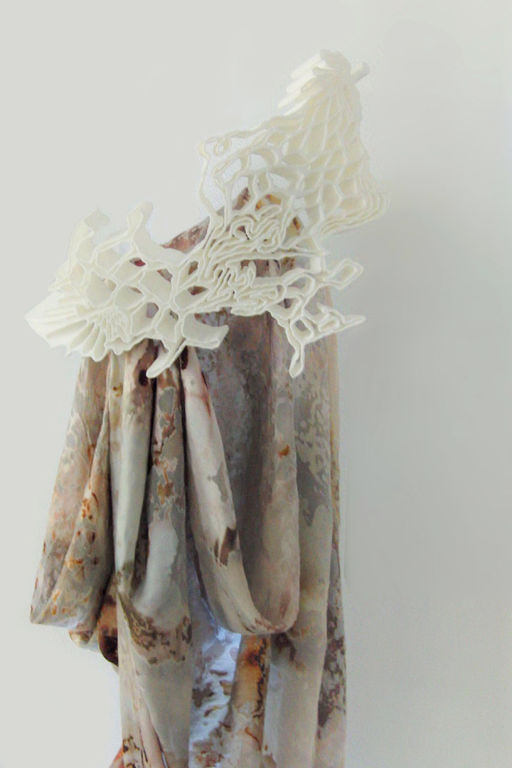
In an effort to visualise bacteria cultures the textile collection Bacterial Motility looks to innovative technologies such as Shape Memory Alloys and 3D printing to create the most natural effects.
Bacterial Motility was inspired by the growth of bacteria populations and intends to make the usually invisible bacteria visible, thus creating a second layer on the human body. It is the final collection of Erdem Kiziltoprak, a recent graduate from the Central Saint Martins BA course in Textile Design. I spoke with him about his recent work.

What inspired you to make this collection?

I was exploring single-celled microorganisms and fascinated by the growth, shapes and the movement of invisible membranes in nature, such as bacteria populations. As growth and movement are key aspects of future designs I wanted to take them to a new level. My research question for this project was “How can we translate scientific data into textile design representing a hybrid language in-between science and future design?” In my project I investigated scientific data and methods with textiles in order to find a balance between individual identity and the invisible membranes.

In your collection you transform scientific imagery into textile designs. What methods and techniques did you use to make this translation?

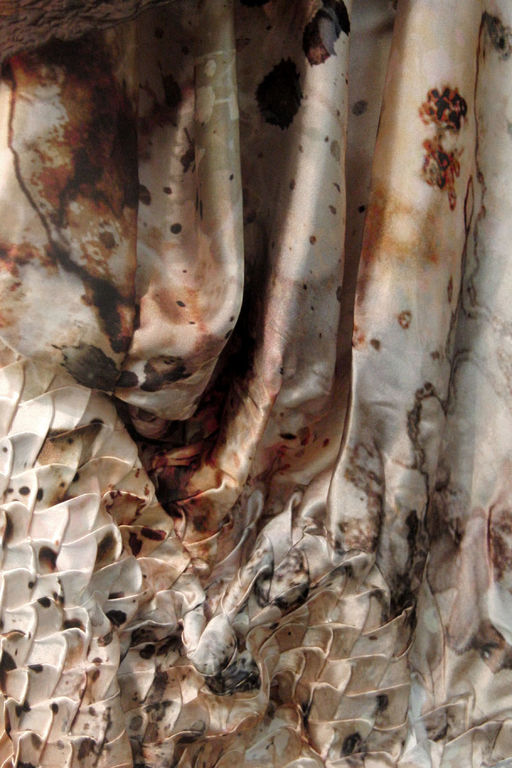
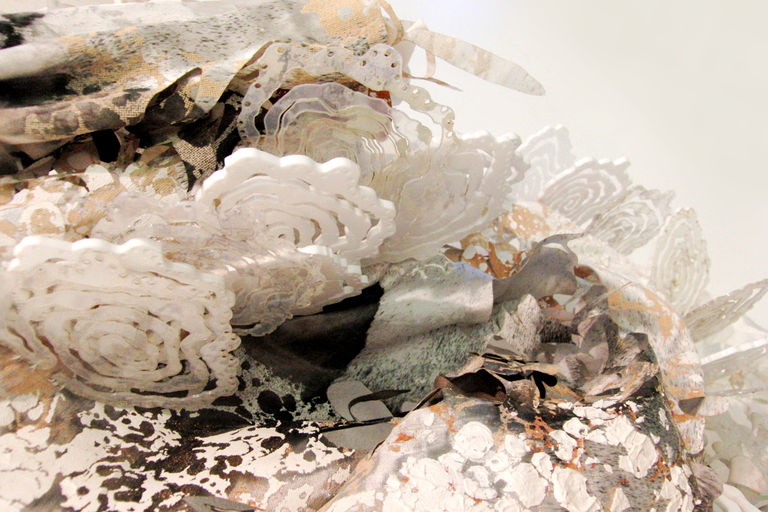
To understand the nature of the invisible bacteria I grew my own bacteria population. During the growing process I did time lapse recording to explore the growth, movement and the amazing shapes of the bacteria, which through the recording became visible. I used different techniques to mimic my bacteria population and their characteristics such as abstract drawings, rusting, 3D crafts, origami, knitting, rapid prototyping and exploring some unusual and smart materials (such as SMAs). During the printing process I used unconventional materials to screen print on silk rather than pigments or acid dyes. I used artists’ mediums, plaster of Paris and sculptors materials for fabric printing. I also used a mixture of black/green tea solution, sugar contents, Kambucha mother (yeast and bacteria mix) and Kambucha tea to grow my own fabric out of bacteria.

What was your motivation for using technologies like 3D printing and Shape Memory Alloys for this specific project?

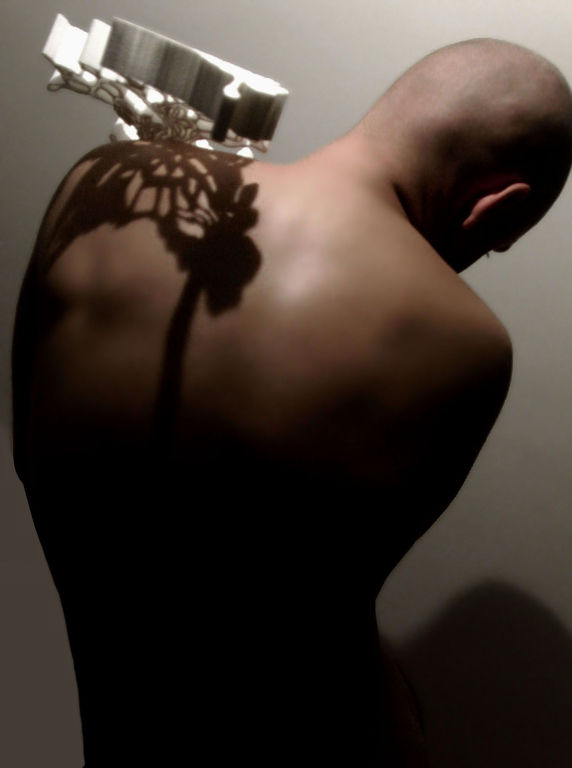
When cultivating my own bacteria population I was fascinated by the growth and what was becoming visible in little petri dishes. According to time-lapse video recordings I started to draw the shapes of the population, which were very organic. My main idea was to create contemporary body jewellery for men. I wanted to link the different combinations of areas together (Fashion/Textile and Science/Technology) to create a platform for human being and skin flora. I turned my 2D drawing ideas into tangible 3D creations thus creating shadow jewellery, which was a sort of shadow tattoo on the human body representing the growth of bacteria as a second growth layer on skin.

The idea behind my bacteria fabric was same as for the rapid prototyped shadow jewellery. By using the shape memory alloys I wanted to mimic the movement and the slow growth process of the bacteria population. Using SMA was the best way to create that organic soft movement to interpret the movement of my organisms into an engineered textile design.

What made you decide to include porcelain in this technology oriented collection?

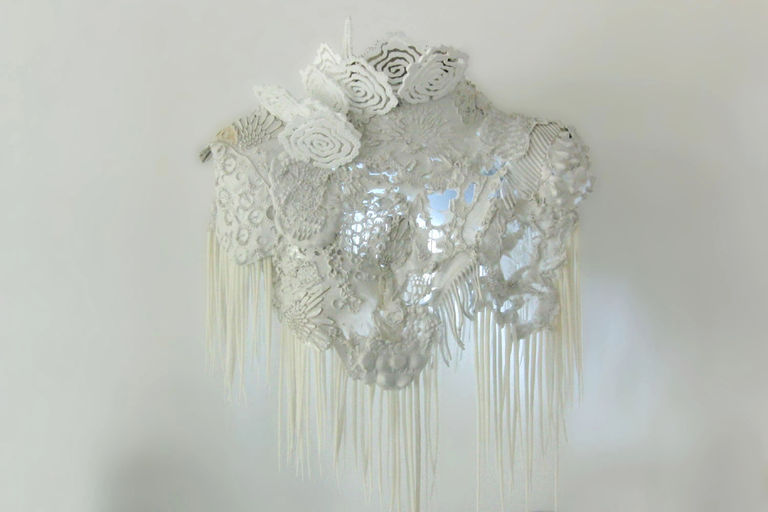
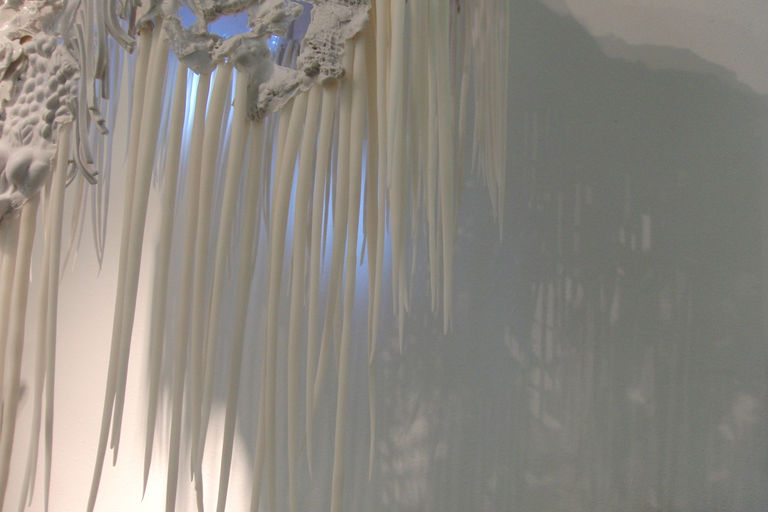
I have always been very experimental and like using different techniques and materials rather than the usual ones. Moreover, with contemporary bio-textiles developments, the known approaches and the way that we perceive things has changed. Thus, it is important to blur the boundaries rather than hanging on the traditional way. During my experiments I ended up with a new technique, which is a sort of porcelain but not a real one. With mixing some different sort of materials, my porcelain fringes are %100 bendable and have an organic look. While I was looking at one of my bacteria samples under a microscope, I saw that the bacteria which I grew out of a nail sample in a petri dish was producing shapes which were like tiny soft fringes, like soft moving spiky elements. The idea behind my fringes came only from this sample and it was a completely white bacteria. So I created my body jewellery sample in white as well.

Did using these specific materials and technologies change your design process?

It actually did not change the whole design process but it did change some of my ideas. When you make some mistakes during your experimentations, you sometimes come up with an amazing outcome (like in my bendable porcelain fringes) and you can change your first idea. Thus that happened to me twice in this project. Moreover, exploring the nature of shape memory alloys, especially learning how to train my own alloys, was a bit time consuming. [Ed. Erdem eventually trained his SMA with a heat gun!]

Will textile designers have to broaden their skills into territories not normally associated with textile design if they want to keep up with current developments in design?

I think so. Textile and Fashion are a form of art and it is all about having the potential to shift existing design boundaries and re-shape how we live. Designing cannot be stable and people has to engage fully with the challenges of creating for the 21st century. To broadening the skills in different areas means embracing the new innovations and creating a hybrid language in-between art and design. Thus it is very important for me to explore my work field not only within itself but to include every aspect of life that I can relate and translate into textiles and fashion.

Do you think that new technologies have the capacity to change the aesthetic conventions in textile design?

Yes they have, but in a more innovative and more aesthetic way. It is not just about creating textiles or fashion but it is about creating an incredible link between a form of art and our lives and our needs. The known approaches and the way that we perceive things have changed. The ideas for innovation and creation have to change in the same way. Rather than creating in a traditional way, using technology and science within textile design creates an amazing language between the viewer/wearer and the design itself.

Erdem also elaborated on some of his works specifically.

“My bacterial colony print [Ed. shown below] was originally a silk viscose fabric. However I used artists’ acrylic mediums and a screen-printing liquid mix on it before the printing process. So the actual fabric became a see through, soft / papery feeling fabric, loosing its silk viscose characteristics. Then I printed my design with unusual materials such as Plaster of Paris and yeast. So when the yeast started to produce moulds, I got living bacterial patterns on the fabric. Finally I attached laser cut acrylics, which are my translation of bacteria shapes.”

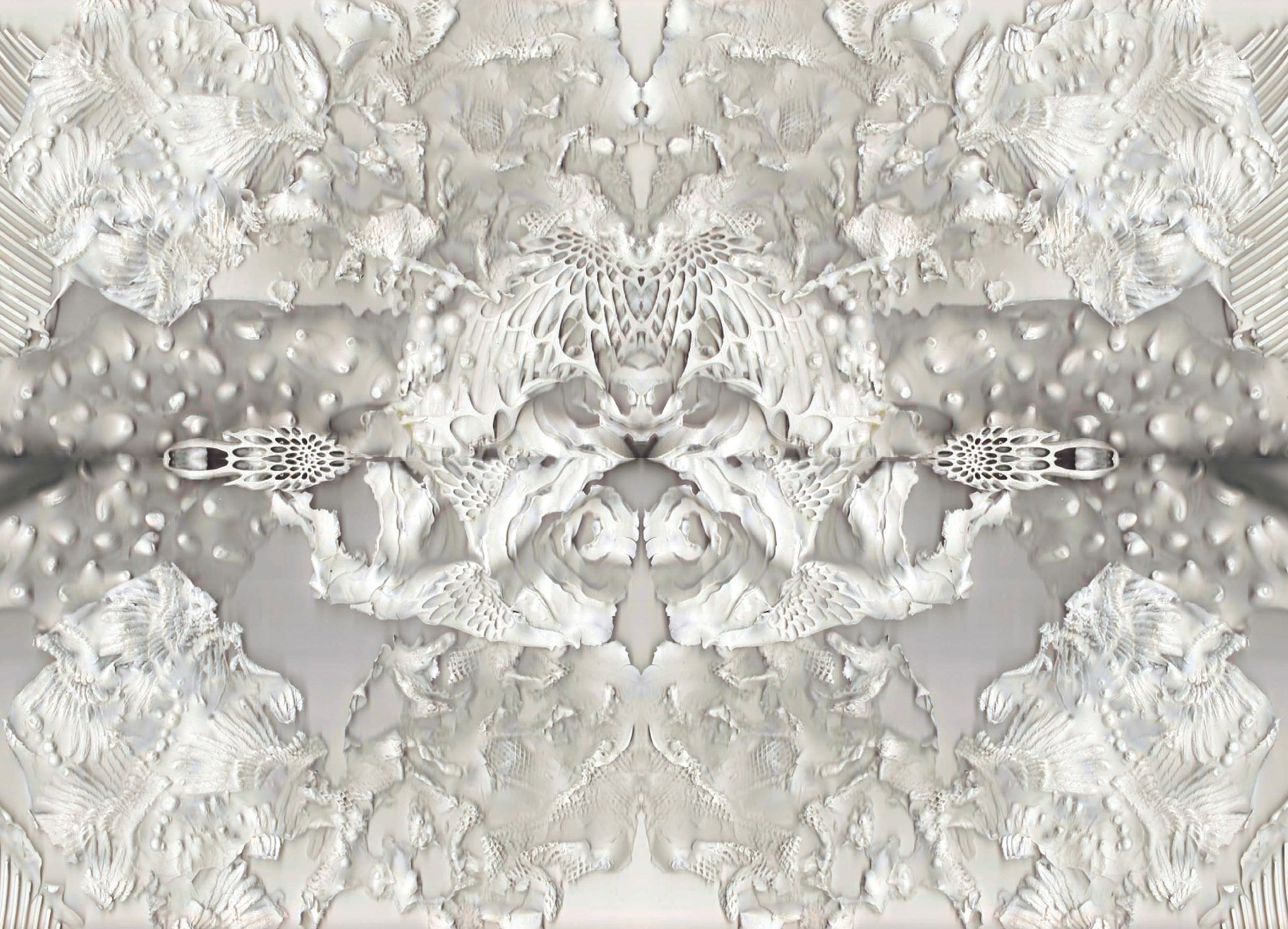
“This picture [Ed. below] shows my main print design. Before I tailored my silicone and porcelain body piece into a garment shape, I scanned each of the silicone mould pieces into PC. Then I organised them in Photoshop. Then I just mirrored them and got this result.”

Bacterial Motility: a second skin that grows and moves was last modified: July 29th, 2011 by Melissa Coleman
July 29, 2011 0 comment
0 Facebook Twitter Google + Pinterest
Materials

Dynamic Relief Makes Textile Animations With Air

written by Melissa Coleman

Without a doubt this is one of the most elegant methods to create a moving textile that I have encountered thus far. Dynamic Relief by Industrial Design students Fauzi Al-Kaylani, Sander Bogers, Nicholas Nelson and Willem Willemsen uses air to create organic animations in textiles.


The method they used to create Dynamic Relief is not unsimilar to the principle of an inflatable mattress. The textile is made out of several individual layers that are fused together with a heat press. The layers alternate between rubber glue foil to make the fabric air tight and elastic fabric to make the pockets expand. A final fabric layer is added on the outside to make the fabric more pleasant to touch.

By using a laser cutter to cut out shapes into the central layer of double sided heat press foil they created little air pockets in the fabric that expand when air is blown into it. Where the foil is cut into a path the layers do not stick together and air is free to run through the fabric creating a sequential effect that looks more organic than electronic.

If you’ve seen Diana Eng’s Fairytale Fashion Show or the works by Cocky Eek you will know that this is not the first time that inflatables are being used to create a dynamic textile, however this is certainly the most controlled and crisp effect that I have seen. It promises to be a technique that will be copied many times and puts inflatable fashion back on the map, providing a welcome alternative to motors and SMA’s as a technique to create dynamic surfaces.

Dynamic Relief was made during the Intelligent Textiles module at the Wearable Senses research theme at Industrial Design at the Technical University of Eindhoven. The project was coached by Stephan Wensveen and Michel Peeters.

Dynamic Relief Makes Textile Animations With Air was last modified: June 7th, 2011 by Melissa Coleman
June 7, 2011 0 comment
0 Facebook Twitter Google + Pinterest
Materials

Pretty Smart Textiles 2011 at Future Textiles

written by Melissa Coleman

In case you missed it last year: this year the exhibition Pretty Smart Textiles is travelling to Denmark. Pretty Smart Textiles 2011 will be part of Future Textiles, a series of international events on smart textiles organised by the Knowledge Centre for Smart Textiles. The exhibition is taking place at TEKO Design and Business in Herning, Denmark from May 2nd to May 19th 2011.

Pretty Smart Textiles showcases electronic textiles made by Dutch artists and designers, who through their contemplative aesthetical designs are distinguishing themselves on the world stage. This year a number of new works have been added to the exhibition, most notably Intimacy Black by Daan Roosegaarde and Anouk Wipprecht, shown in the picture above, which will be exhibited for the very first time. Other new works include Pseudomorphs, InBetween, E-Pressed, See-Thru-Me, Secret Keeper Gloves, Social Skin and the Lace Sensor Project.

The exhibition explores themes that arise from reflections on technology in today’s society. Some works visualize psychological dimensions and pinpoint difficulties of social interaction, using technology to externalise or complement the imperfections of human beings. Other works in the exhibition grapple with the abstract and clinical aspects of technology, trying to make the invisible visible and the intangible tangible. Then there are those who in their work simply embrace the new possibilities and aesthetics of technology, using traditional techniques like quilting, spinning and knitting, and giving them a new dynamic through sound, movement or light.

Exhibition Days:
Monday 2 May
Tuesday 3 May
Friday 6 May
Saturday 7 May
Sunday 8 May
Monday 16 May
Thursday 19 May

The exhibition is also open for invitees during the events.

Opening Hours: 10:00 – 16:00

Entrance Fee: Free of charge

The brochure can be downloaded here.


Photo Intimacy Black: David Joosten

Pseudomorphs by Anouk Wipprecht

InBetween by Anja Hertenberger

E-Pressed by Anja Hertenberger, Barbara Pais, Danielle Roberts

See-Thru-Me by Meg Grant

Secret Keeper Gloves by Meg Grant

Social Skin by Seçil Uğur and Laura Duncker

Lace Sensor project by Anja Hertenberger and Meg Grant

Pretty Smart Textiles 2011 at Future Textiles was last modified: April 23rd, 2011 by Melissa Coleman
April 23, 2011 0 comment
0 Facebook Twitter Google + Pinterest
Uncategorized

The philosophers vest reveals the numbers that define us

written by Melissa Coleman

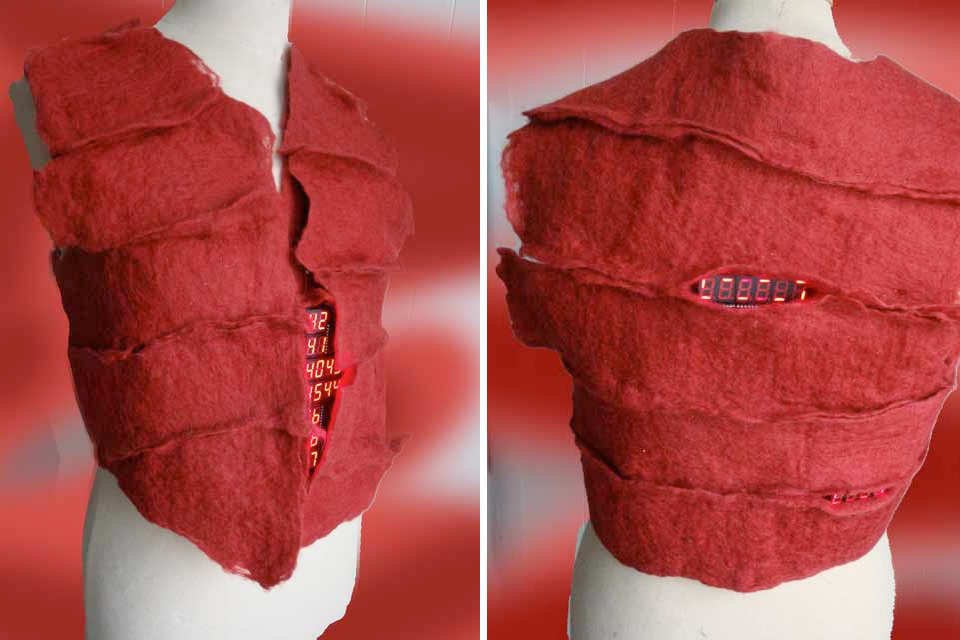
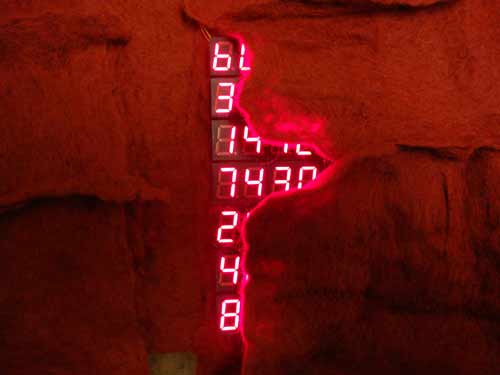
The philosophers vest by contrechoc, artist name of Bram van Waardenberg, poses the question of whether there is a part of us that cannot be digitalised. In a reaction to our digital society it stores our pin codes, security numbers, the time to pick up the kids from school, bits of text, patterns, flows of numbers, half sentences… Does adding up all possible digital data give a clear picture of who someone is? Will data ever be able to define a whole person?

The vest is made out of two layers of red handmade felt, programmable chips and double digit displays. It reminds me somewhat of a meat garment, except this the textile flesh looks like it’s slowly being taken over by technology. Is wearable technology turning us into cyborgs? Perhaps it is.


The philosophers vest reveals the numbers that define us was last modified: February 21st, 2011 by Melissa Coleman
February 21, 2011 0 comment
0 Facebook Twitter Google + Pinterest
Materials

Secret Keeper Gloves

written by Melissa Coleman

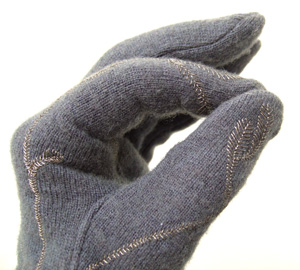
Ever had a secret that you couldn’t tell anyone? For all those people who really want to spill but shouldn’t wearables designer Meg Grant has made the Secret Keeper Gloves. Watch her explain how it works in this video.

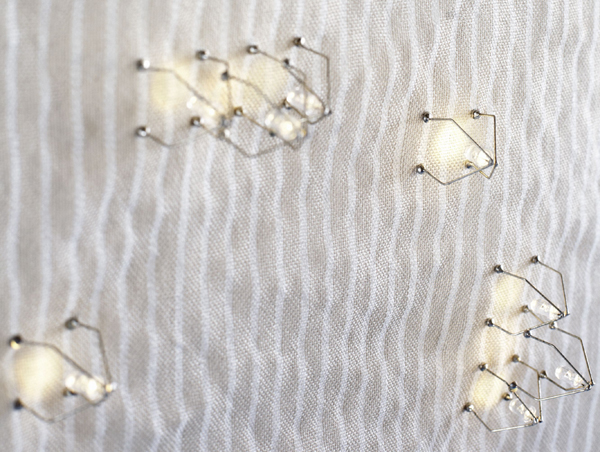
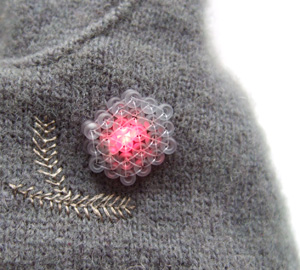
I love the intuitive interaction in this project. The actions that make it work seem to suggest that you’re physically holding the secret in your hands. Also check out the beautiful embroidery and Meg’s trademark: making LEDs pretty by sewing beads together and using them to diffuse the light.


Secret Keeper Gloves was last modified: January 25th, 2011 by Melissa Coleman
January 25, 2011 0 comment
0 Facebook Twitter Google + Pinterest
  • 1
  • 2
  • 3
  • Facebook
  • Twitter
  • Linkedin
  • Youtube
  • Email
Footer Logo

© 2016 Fashionging Tech. All rights reserved.


Back To Top